Wensi Tofu
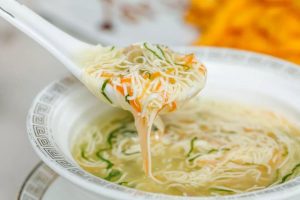
Wensi Tofu is the pinnacle of Huaiyang knife skills. A block of silky soft tofu is sliced into strands as fine as hair — so fine that hundreds of them bloom like clouds when gently stirred into a clear chicken broth. The dish was created by Monk Wensi at Yangzhou’s Tianning Temple during the Qing Dynasty and later became a favorite of Emperor Qianlong.
Cutting Wensi Tofu requires supreme concentration and years of practice: steady hands, a quiet mind, and perfectly uniform strands. In a true Wensi Tofu soup, the tofu filaments are thin enough to thread a needle. Today, chefs continue to reinvent this classic — some serve it with jujube jelly and caviar, creating a delightful sweet-savory fusion
Yangzhou Fried Rice
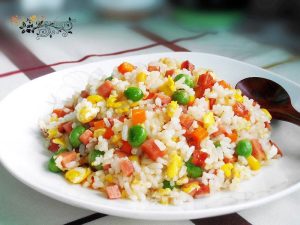
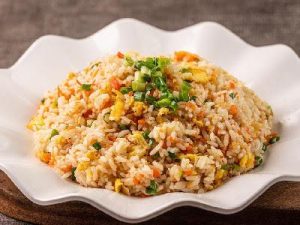
Yangzhou fried rice is not just fried rice — it’s a dish with heritage. Each grain of rice stands separate, coated in egg and wok aroma. A premium version contains over ten ingredients: ham, eggs, shrimp, chicken, dried scallops, shiitake mushrooms, and green peas. The authentic Yangzhou fried rice follows the principle of “egg embracing rice, rice carrying fragrance” — precise heat control ensures the rice is chewy without being sticky.
Today, Yangzhou fried rice has become Huaiyang cuisine’s global ambassador. Some versions are wok-fried live by intangible cultural heritage inheritors, with a single serving priced at 238 RMB — not just a meal, but a culinary performance
Minced Crab Meat Pork Ball
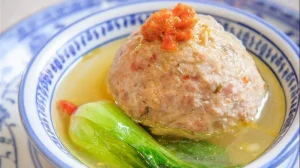
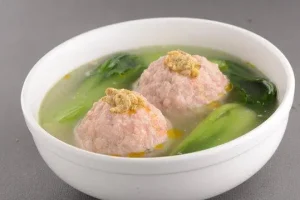
The crab meat lion’s head is the ultimate testament to Huaiyang culinary craftsmanship. The pork belly is hand-cut into pomegranate-seed-sized pieces — never ground — then mixed with crab roe and crab meat, and molded into fist-sized balls. Slowly braised for hours, the meat becomes tender and melts in the mouth without a hint of greasiness.
The dish gets its name from the meatball’s resemblance to a lion’s head. Served in a clay pot, the meatball is so tender you can break it apart with a spoon. The broth seeps into every strand of meat, while the crab’s umami mingles with the pork’s richness. This dish has graced state banquets, winning over dignitaries from around the world.
Multiple Layer Oil Cake
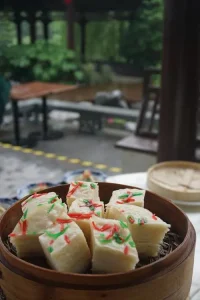
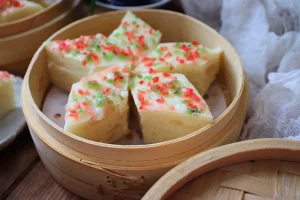
Thousand-Layer Oil Cake is the crown jewel of Yangzhou’s pastry tradition. Alongside Jade-Colored Siu Mai, it forms the famous “Two Delicacies of Yangzhou.” Its defining feature is its structure — 64 distinct layers, each clearly visible.
The cake is made using a slow-fermentation method. The dough is proofed for an extended period at low temperature, then folded repeatedly during rolling to create 64 paper-thin layers, with sugar and lard spread between each. After steaming, it is cut into diamond-shaped pieces, revealing a translucent芙蓉色 (lotus-white) interior. The surface is garnished with red and green threads for a festive touch.
In 1983, Yangzhou master pastry chef Dong Dean presented Thousand-Layer Oil Cake at the National Culinary Competition. His exceptional skill astonished the judges, earning him the title of “China’s Best Pastry Chef.” One bite delivers a soft, sweet, and melt-in-your-mouth texture — and those 64 layers are not just a marketing claim; you can taste every single one.
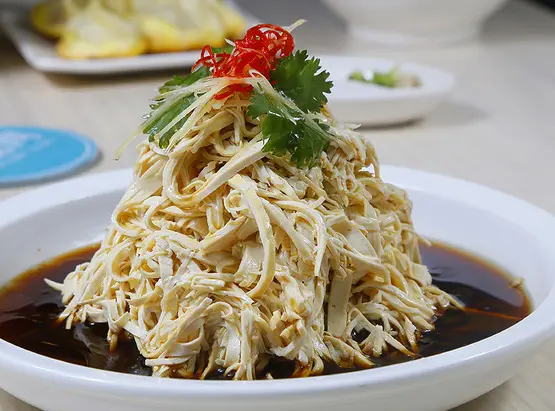
Boiled Shredded Dried Tofu
Tang Gansi is the quintessential starter of Yangzhou’s morning tea. A single block of dried tofu is sliced paper-thin — so thin that a 2 cm thick piece can be cut into 30 slices and then into hundreds of silky shreds. The shreds are then scalded three times in hot water to remove any raw bean flavor, dressed with hot soy sauce, and topped with ginger shreds, dried shrimp, and cilantro.
The celebrated writer Zhu Ziqing once wrote in his essay “On Yangzhou”: “It is so pure and clean that it doesn’t interfere with enjoying other dishes.” For Yangzhou locals, a bite of Tang Gansi paired with a soup dumpling is the perfect start to a leisurely morning.